Welcome

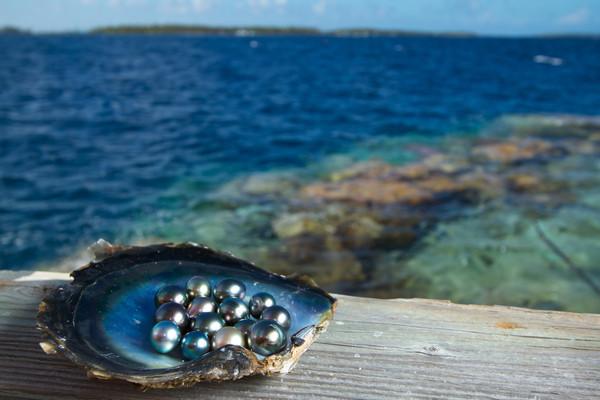
Welcome to your online source for farm-direct Tahitian black pearls. At Kamoka Pearl our goal is to bring the jeweler the highest quality pearls at farm prices. We pride ourselves both on the excellence of our pearls and on the socially and ecologically responsible way in which they are produced.

History of our farm

My name is Josh Humbert, owner and manager of Kamoka Pearl. Our pearl farm is located on the atoll of Ahe, a ring of coral that juts a few feet above sea level and encircles a 75 square mile lagoon. Ahe is located 350 miles north east of Tahiti in the Tuamotu Archilpelago. The kindness of the people and the surreal nature of the sea, land and sky make Ahe the essence of a tropical paradise.My family first arrived here in the early 1970's on a sailboat my parents built on a shoestring budget. My family decided to settle down and built a palm-leaf house.

History of our farm

My brother went to the only elementary school on the island while I started a lifelong love affair with the ocean and its inhabitants. My father fished with the locals and converted the center of our sailboat into a freezer that could transfer Ahe's fresh fish to the market in Tahiti. All was not well in paradise forever; eventually our sailboat saw its tragic end on a neighboring atoll and our family split up soon after. My father settled in Tahiti and my brother and I returned to California with our mother.

History of our farm

Our family always kept a connection to Ahe. In 1991 my father and my brother returned and founded Kamoka Pearl. My father has always been a man of the sea; his keen understanding of it told him great things could come from the nutrient-rich water surrounding a certain motu near the mouth of Ahe's lagoon. I joined the project a year after its founding as my brother returned to the US to finish a degree in architecture. At this point I was halfway through my marine biology studies when I realized that instead of sitting in a classroom I could learn what I wanted firsthand in the South Pacific with my father.

History of our farm

Soon after settling in Ahe I became friends with a highly experienced Japanese grafting technician and learned the secrets of the trade. I also conducted my own research and experiments, and it wasn't long until the Japanese grafters were trying to learn my secrets as Kamoka pearls rivaled their best pearls.

History of our farm

In 2002 my father sold the farm to me. I got off to a tough start when the pearl market crashed less than a year later. Forty percent of the pearl farms in Polynesia went out of business as prices plummeted. We managed to stay afloat due to the superior quality of our pearls, but it was a difficult time. We were forced to cut our team from 22 to five. Kamoka Pearls has always been run like a family, and it was hard to say goodbye to so many loyal, hardworking people. Since the crash the market has risen about thirty percent, which is roughly the cost of production for most farms.

History of our farm

Our team has increased to ten people, which seems the magic number for the current market. The main reason pearl production remains difficult for farms while pearl prices remain high for buyers is the inefficient distribution network that gets the pearls from farm to jeweler. This website is our solution to this problem, giving jewelers the best prices for quality pearls by using the Internet to bring them directly from our farm.

Our farming methods

Kamoka Pearl is built on a foundation of respect. It is our respect for our work that pushes us to produce pearls of the highest quality. It is our respect for the fragile ecosystem in which we live and work that compels us to use only the most environmentally sustainable methods of aquaculture. And it is the respect every member of our team has for the project and for each other that allows us to continue to excel at what we do. We also believe strongly that today's customer values products produced in a respectful and sustainable manner.

OYSTERS AND PEARLS

Everything we produce comes from the sea. Our oysters start their lives as freeswimming plankton in the lagoon. After three weeks of swimming they begin to grow shells and search for a surface onto which they can attach. We set out “collectors” during strategic times of year – usually corresponding to changes in the season – that offer ideal places for the young and vulnerable oysters to seek refuge and mature. Laurent carrying a mature collector, ready for grafting.

OYSTERS AND PEARLS

After around two and a half years the oysters are large enough to start producing pearls. This process is started by a graft, a painstaking procedure similar to surgery. A successful grafter uses sterile and razor-sharp tools, antibiotics, an eye for detail, and a very, very steady hand. The mantle of a living oyster is the organ that produces the splendid iridescence called nacre, for which pearls are valued.

OYSTERS AND PEARLS

Grafting involves transplanting a small piece of mantle from one oyster to another. The bulk of the research I have done at Kamoka has been focused on the complex nature of the graft tissue which largely dictates the quality of a pearl. Our donor oysters are meticulously chosen for the beauty of their colors, as their mantle creates the eventual color of the pearl.

OYSTERS AND PEARLS

The next step in the grafting process is the insertion of a nucleus, the six to eight millimeter ball around which the pearl grows. The Japanese researchers who pioneered the grafting process decided that the shell of a wild mussel in the Mississippi river basin had the appropriate density for a pearl nucleus, and to this day most nuclei come from this unlikely mollusk. This practice leads not only to inferior pearls, but has also endangered the very existence of this North American mussel due to over-fishing.

OYSTERS AND PEARLS

At Kamoka, virtually all our nuclei are made of mother of pearl (MOP), a natural product of our very own Pinctada. Margaritifera oysters or their Pinctada Maxima cousins. We were the first company in Polynesia to use MOP nuclei, and the Tahitian Pearl Farming Board (La Service de la Perliculture) found in independent tests that our nuclei produced three times more A grade pearls than any other nuclei type.

OYSTERS AND PEARLS

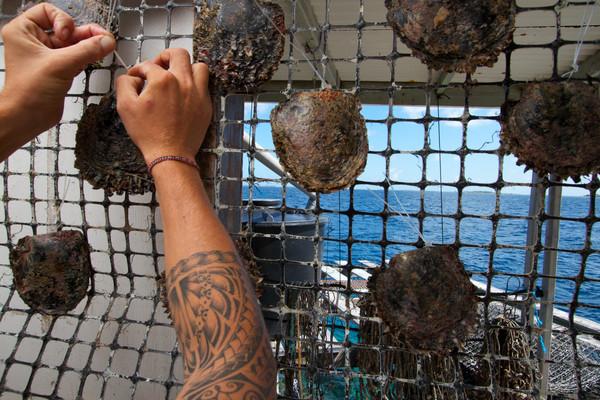
Immediately after the grafting operation the oysters are harmlessly drilled and placed inside protective baskets. The baskets are then suspended on long lines in the clear water of the lagoon for about a year and a half as the pearls inside them form and grow. Finally the oysters are removed and their pearls are gently extracted. A second graft is then performed, this time with a much larger nucleus that roughly corresponds to the size of the extracted pearl. At the harvest of this second pearl a third graft of even larger proportions is sometimes performed. Although extremely rare, we have used pearl nuclei up to 18 millimeters in diameter! Unfortunately every successive pearl sees the increasing age of the oyster and the subsequent decline in quality. This is why very large pearls of excellent quality so rare.

ECOLOGICAL RESPONSIBILTY

Kamoka Pearl was founded on Ahe because of the beauty and vitality of its waters, and we have always strove to be good custodians of the lagoon, the sea, the island, and the many organisms that live here. We are essentially farming wild animals in a wild environment, and our goal is to do it respectfully and sustainably. We work towards this both in the way we live and in the way we work.

ECOLOGICAL RESPONSIBILTY

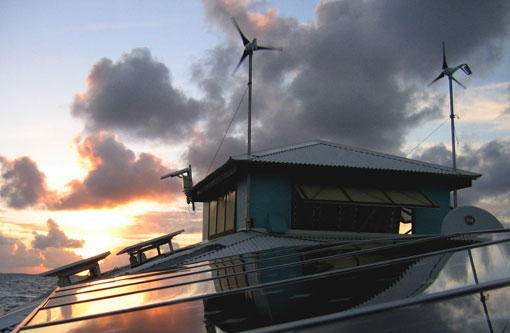
All our electricity needs are met by solar and wind power. Our fresh water is supplied by rainwater catchment systems. Our septic systems are fully biodegradable. Our choice of MOP nuclei prevents the further overexploitation of North American freshwater mussels, relying instead on a byproduct of our own industry. In addition to all this, we can proudly say that our oysters have actually increased the fish population of our lagoon. Oysters are grown high above the floor of the lagoon in order to provide them with optimal access to oxygen and plankton.

ECOLOGICAL RESPONSIBILTY

However, a myriad of other organisms take advantage of these suspended ropes near the surface and latch onto the oysters, harming their growth and severely affecting pearl quality. Typically, this obstacle is dealt with by periodically removing the oysters from the water and blasting them clean with high-pressure hoses. This practice results in numerous environmental problems. For example, the blasting breaks up caustic anemones, causing a population explosion that the environment cannot assimilate. Many atolls in French Polynesia have suffered because of this.

ECOLOGICAL RESPONSIBILTY

In addition to the harm to the environment, the anemones degrade pearl quality and pose a hazard to divers. Ten years ago my father took the anemone problem brought on by the pressure hoses to the attention of the media. Just last year I had a petition signed by almost half of the entire population of Ahe that banned the hoses once and for all. When oysters grow naturally on the sea floor they are cleaned by the nibbling of fish. We rely exclusively on this free source of labor to clean our oysters; placing them in carefully selected zones where the right varieties of fish keep them clean to the benefit of all. This is just one example of the many ways Kamoka farms pearls in harmony with the environment.

SOCIAL RESPONSIBILTY

The team members of Kamoka Pearl are like family. We live together, eat together and work together. Every member of the team has respect for each other, for their work and for our environment. Most pearl farms operate with a military hierarchy and a clear separation between management and employees.Workers are paid little and division between people occurs from job instability.

SOCIAL RESPONSIBILTY

This inevitably results in poor working relations, lower quality of work, thievery, and high employee turnover. At Kamoka unity is paramount, team members are paid exceptionally well, and we suffer from virtually none of these problems.Our turnover is also notably low. Our oldest employee is our full time grafter Timiona Tehaai, who joined us in 1993.

Pearls

Pearl classification is notoriously arbitrary so for simplicity's sake we'll keep to the official system put into place by the Tahitian pearl promotion board (GIE Perle de Tahiti www.perledetahiti.net). The value of pearls is governed by the following factors in order of importance: size, quality and shape.

Pearls

Tahitian black pearls that have been nucleated typically range in size from 7 to 18mm in diameter. Larger pearls exist but anything beyond 16mm is extremelyrare.Quality is broken down into A, B, C and D categories. Another system of grading exists that is defined by A through AAA. Both systems are valid but both also have degrees of subjectivity depending on the seller. Honest sellers understand the long term benefits of proper grading.

Pearls

Before getting into the different grades, the buyer should know some background on our pearls. The Tahitian government imposes a minimum nacre thickness on all pearls exported. You can be sure that your pearl has at least . 8mm on it's nucleus. If this doesn't sound like much, it should be compared with the typical .25mm on ordinary white pearls from Japan. If it doesn't have . 8mm when x-rayed it is ground into powder by a scary little machine outside of the Service de Perliculture x-ray room. To value a pearl, the buyer must understand the various criteria that I have tried to lay out in the most user friendly way possible.

Pearls

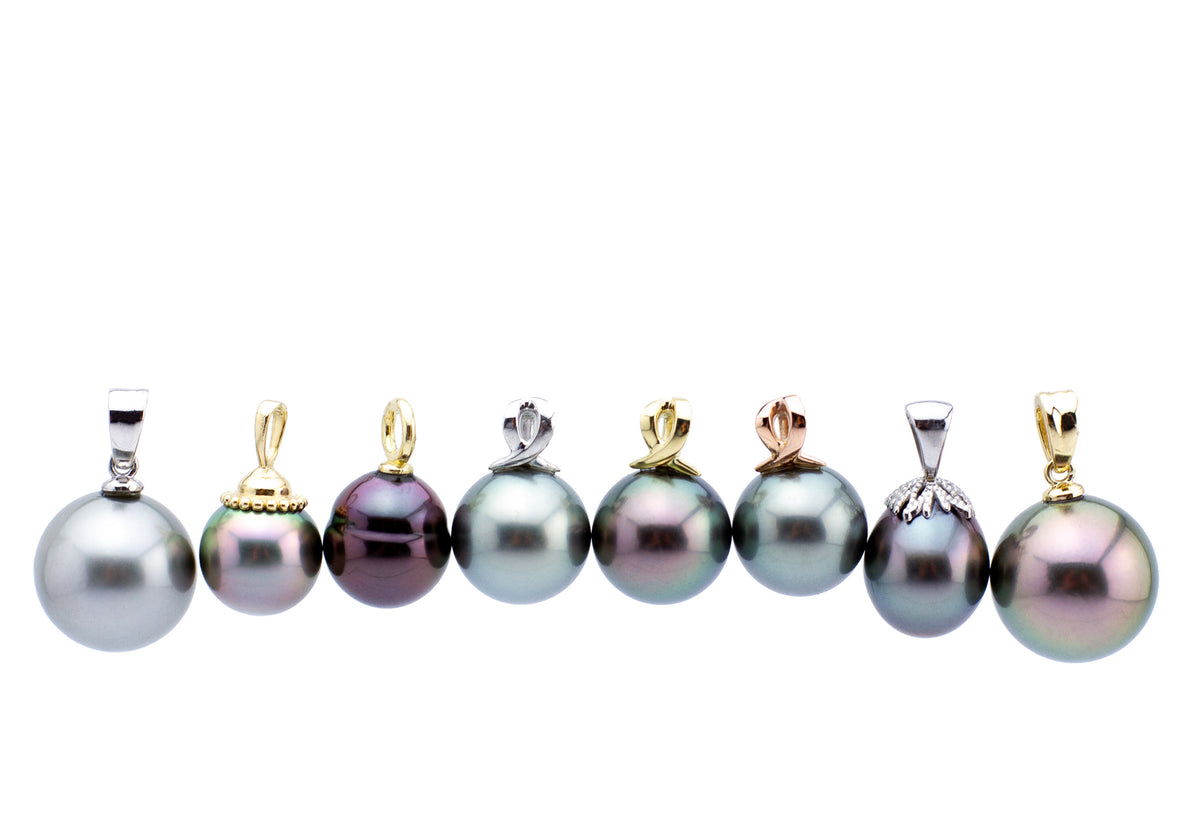
They are: Surface luster heavily influences quality as well. If you have a 18mm round, green pearl that doesn't shine, you don't have anything to get excited about. Color is a very subjective official criterion for judging quality. To me it's everything because as a farmer I am always striving for the most perfect, colorful pearls I can produce. Regionally however, it varies wildly. Europe prefers lighter shades as well as silver tones while Asia leans heavily on the darks. America seems to be somewhere in the middle.Shape and size have no bearing on quality. A seven-millimeter baroque can be an A as well as a D.

Pearls

Orient is something seldom understood because it can only be observed in pearls that have it. Tahitian pearls are excellent ambassadors of this elusive property because of their amazing range of colors; colors that are often mixed in unlikely combinations. Only on a pearl can you have pink and green co- existing beautifully. Orient is the color of the pearl that radiates outward from the middle.

Pearls

Pearl quality is broken down in the following way: A grade pearls are officially known as 90% perfect with great luster and no more than two imperfections within the 10% of allotted surface. B grade pearls must have great luster as well but tolerance swings to 70% of the total surface being without flaws. C grade pearls must have decent luster with 40% of the surface being “clean.” C grade pearls often find themselves in strands as drilling from one side to the other tends to conceal what can't be hidden in pendant or ring settings. D grade pearls are more characterized by their consummate flaws than anything else. Luster is variable.

Pearls

Shape is probably the most challenging for the uninitiated but does not have to be difficult. Tahitian pearls vary wildly but can be boiled down to the following categories: Round pearls are the most classic and a good starting point. To be classed as round they must have a diameter variance of less than two percent. This means that a 10mm pearl cannot be larger than 10.2 or 9.8mm if measured across a different diameter. Semi-round pearls are usually mixed with rounds because of their strong tendency to look the same. They are allowed a diameter variance of two to five percent which becomes noticeable to eye. Most pearls have an axis of symmetry.

Pearls

This means that you can drill it from one end through to the other, spin the pearl along that axis and not see it wobble. Pearls that wobble are known as baroques. Baroques have personality and are a personal favorite. Semi-baroque is a large category that encompasses drops, buttons, ovals and all of their variations. It is said that a perfect drop is every bit as valuable as a perfect round, no doubt due to its rarity. The last category is the circles. Circular rings in the form of the pearl that do not descend lower than 1/3 of the pearl define circled pearls. It's unknown why but circled pearls are by far the most colorful.

In the news

Story in Patagonia catalog of Yvon Chouinard and Jeff Johnson's visit at the farm. Tamata et l'Alliance. French sailing legend Bernard Moitessier tells a little of family's history in the early 70's. Air Tahiti inflight magazine. An in depth profile of our farm and the atoll of Ahe.

To be viewed with Firefox for Mac users.

Contact

Josh Humbert | Tahiti: 689.79.13.71
Ph/Fax: 689.41.37.35 | Kamokaperles@mail.pf
Bp 41982 | 98713 Papeete -Tahiti | French polynesia

leplanb